The Declaration of Christ: “My God and Your God”
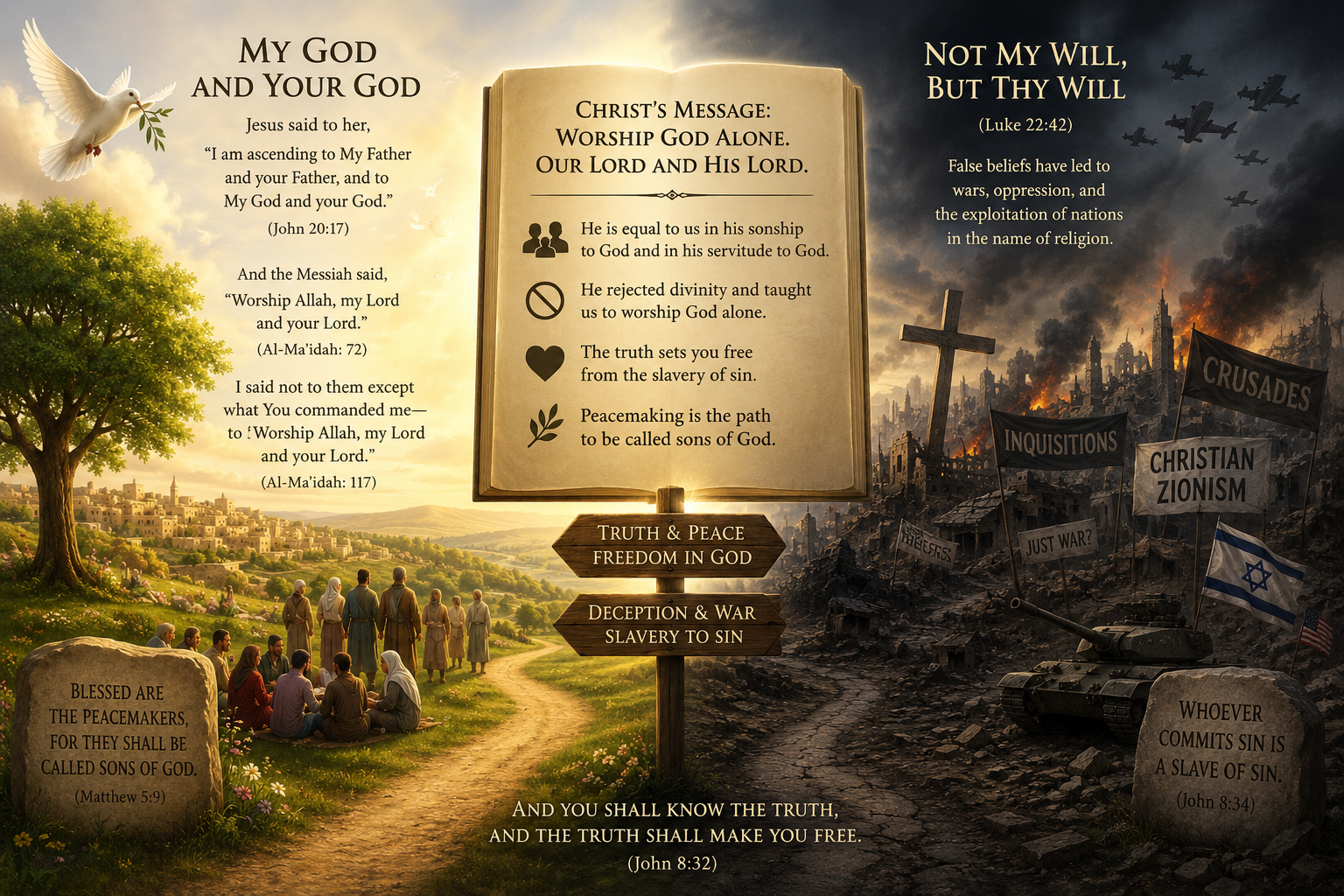
It is striking to find in the Gospel of John the words of Christ to Mary Magdalene after the crucifixion: “Jesus said to her, ‘Do not cling to Me, for I have not yet ascended to My Father; but go to My brethren and say to them, I am ascending to My Father and your Father, and to My God and your God.'” (John 20:17)
His statement, “My Father and your Father, and My God and your God,” should arguably settle the debate regarding Christ’s divinity and his literal sonship to God once and for all. He declares that he is equal to his people in his sonship to God and equal to them in his servitude to God. They are children of God just as he is His son, and God is his God just as He is theirs! In this phrasing, any interpretation that would make his sonship to God different from theirs vanishes, and the notion of his divinity is completely dispelled by the confirmation that God is his God just as He is theirs.
The Alignment of the Gospel and the Holy Qur’an
This is echoed in the Holy Qur’an: “And the Messiah said, ‘O Children of Israel, worship Allah, my Lord and your Lord.'” (Al-Ma’idah: 72) “I said not to them except what You commanded me—to ‘Worship Allah, my Lord and your Lord.'” (Al-Ma’idah: 117)
It can be inferred from these Quranic verses that Christ (peace be upon him) emphasized and repeated the phrase “My Lord and your Lord” or “My God and your God” frequently. This is evidenced by the first verse stating that this is what Christ used to say—without linking it to a specific occasion—and the second verse noting that he will testify to this on the Day of Resurrection to refute any charge that he taught otherwise. The verse uses a structure of exclusivity (“I said not to them except…”), meaning his entire message regarding divinity was strictly to worship God, who is both his Lord and theirs. Thus, the testimony of the Qur’an and the Gospel align perfectly, leaving no room for doubt.
The testimony of the Gospel carries a particular significance because this specific saying was preserved with great precision due to its association with a momentous event: his survival of death on the cross and his meeting with Mary Magdalene and his mother at the tomb before meeting the rest of his disciples. This event was undoubtedly widely discussed among early Christians before the Gospels were even written. Its presence here does not mean he only said it on this occasion; rather, it confirms that this was his recurring message, familiar to his people, which happened to be preserved through this incident.
“Son of Man” vs. “Son of God”: Metaphor vs. Literalism
The beauty of this Gospel text also lies in the fact that it does not only deny his divinity but also refutes the idea of him being a “Son of God” in a way that differs from the common metaphorical meaning—a concept that would shift him from humanity to divinity. It is worth noting that he reinforces this throughout the Gospels; he consistently referred to himself as the “Son of Man” to dispel any suspicion of being the Son of God in any sense other than the metaphorical one applicable to him and others. While “Son of Man” appears frequently, his description of himself as “Son of God” appears only a few times.
Most importantly, the Gospel witnesses that Christ himself clarified his intent when using the title “Son of God” or accepting it from others. In response to the Jews who accused him of blasphemy and claiming divinity, he replied that he was a “son of God” metaphorically, just as they were described as “gods” metaphorically in the Word of God. As recorded in the Gospel:
“The Jews answered Him, saying, ‘For a good work we do not stone You, but for blasphemy, and because You, being a man, make Yourself God.’ Jesus answered them, ‘Is it not written in your law, “I said, you are gods”? If He called them gods, to whom the word of God came (and the Scripture cannot be broken), do you say of Him whom the Father sanctified and sent into the world, “You are blaspheming,” because I said, “I am the Son of God”?'” (John 10:33-36)
The Historical Impact of Deviant Doctrines
This confirms that Christ (peace be upon him) absolutely rejected the doctrine that he was God or the Son of God in a literal sense. Blessed are those who realize the truth, for the truth sets its people free, as Christ himself said: “And you shall know the truth, and the truth shall make you free.” (John 10:32)
Unfortunately, false beliefs built upon the perceived divinity of Christ have caused harm that extends beyond religious dogma. These beliefs have seeped into ideologies and policies that have enslaved nations and exploited them for corrupt ends, playing a major role in destabilizing world peace—from the Crusades and the Inquisitions to modern Christian Zionism, which toys with global peace and leads the world toward an abyss. This is despite the fact that Christ’s entire message can be described as one of peace.
The Truth That Sets You Free: Slavery to Sin
When Christ said, “The truth shall make you free,” he was speaking to the Jews to show them they would become enslaved to sin. They misunderstood, claiming they were already free as descendants of Abraham. He clarified: “Most assuredly, I say to you, whoever commits sin is a slave of sin. And a slave does not abide in the house forever, but a son abides forever.” (John 8:34-35)
Here, he also foretold that they would be expelled from the land because of sin, having become slaves to it; had they been true “sons of God,” they would have remained. Regrettably, we find that despite all they have faced, many remain insistent on sin, even attempting to harness other nations to support them in their transgressions. Today, Christian Zionism attempts to justify crimes, injustices, and the fueling of wars as the “will of the Lord Jesus!” What great distress Christ must feel in the presence of his Lord, knowing all that has been woven in his name and attributed to him.
Peacemaking as the Path to Divine Grace
That same Christ emphasized that sonship to God is achieved through peacemaking, not through destabilization and the ignition of war: “Blessed are the peacemakers, for they shall be called sons of God.” (Matthew 5:9)
Whoever wishes to be freed from the slavery of sin and to be called a son of God must make peace and abandon the distortions injected into the message of Christ—that great prophet and messenger of peace and love.


No comment