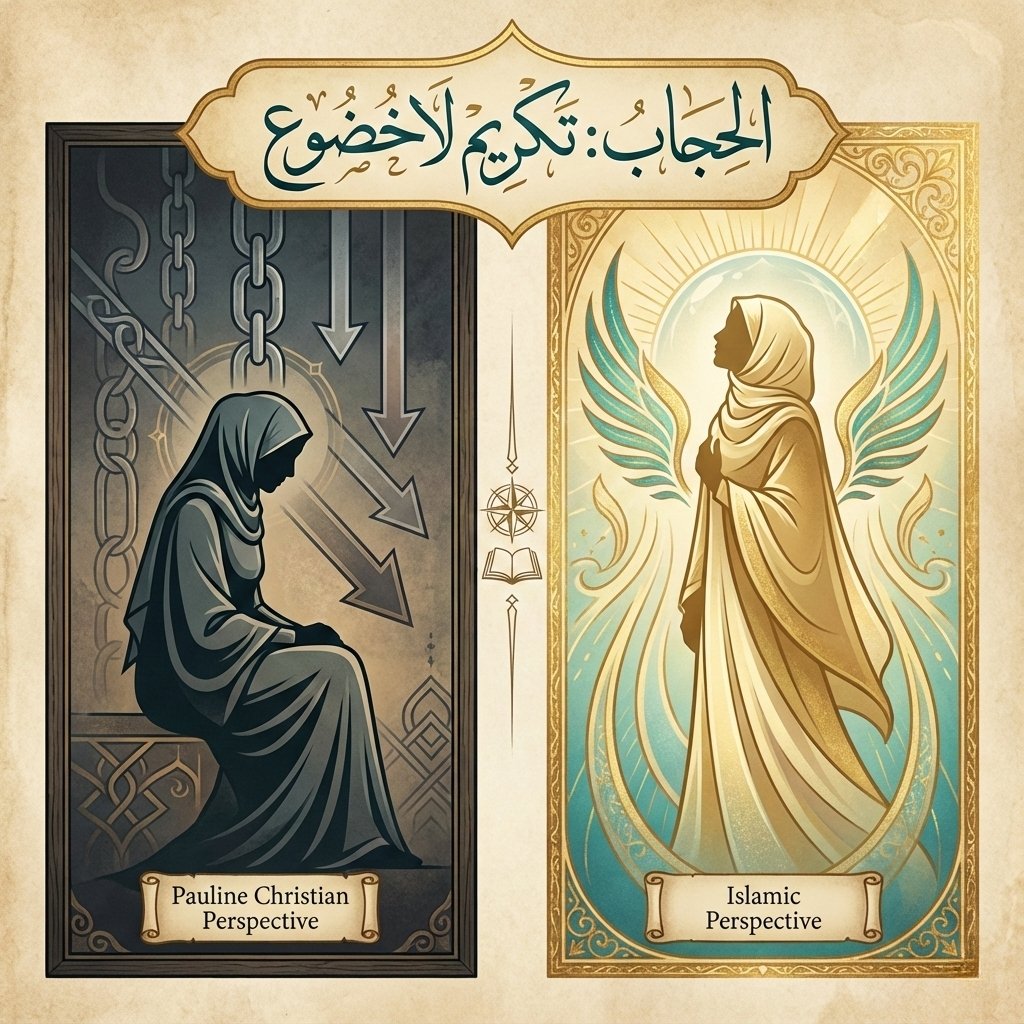
When the modern Western mind criticizes the “Hijab,” it is not actually attacking Islamic legislation as much as it is attacking its own “painful memory” with its historical religious texts. The core of the issue lies in a “historical projection”; many assume that the philosophy of the head covering is identical across all religions, while the truth reveals a radical disparity in both essence and objectives. The Head Covering in Pauline Thought: A Symbol of Inferiority In the epistles of “Paul the Apostle” (as seen in 1 Corinthians), the head covering does not appear as a tool for modesty, but rather as an explicit sign of subjugation. The text establishes a hierarchical order: “the head of the woman is the man,” and dictates that covering her head is an acknowledgment of her being created “for the man” and not vice-versa. Here, the covering is a “sign of authority” placed on the head to announce the subordination of one being to another. Furthermore, it is often linked to the “punishment for the original sin,” for which the woman (Eve) is held primarily responsible. This philosophy is precisely what drove Western societies to rebel—not against modesty itself, but against the “mark of inferiority” that the covering represented in their culture. The Hijab in Islam: A Shield of Honor and Freedom In Islam, however, the philosophy is entirely different. The Hijab is not a “sign of submission” to man, but rather an act of worship that connects the woman directly to her Creator. A Vertical Relationship: A Muslim woman does not wear the Hijab to acknowledge the authority of a husband or a father, but in obedience to God’s command. Thus, it is worn by the queen, the scholar, and the leader alike. Eliminating the “Sin Complex”: Islam exonerated Eve from being solely responsible for the original sin. Therefore, the Hijab is not a “penance” for an ancient guilt; it is a form of empowerment that ensures a woman is recognized for her intellect and character rather than being a body consumed by the gaze of others. A System of Conduct: The Hijab in Islam is not merely a piece of cloth placed on the head; it is a comprehensive system that includes modest attire, dignified behavior, and the lowering of the gaze for both genders, aiming to build a morally sound society. Conclusion: Awareness Before Criticism Attempting to portray the Islamic Hijab as a tool of oppression is a misleading conflation. While the covering according to Paul represented the “subservience of one human to another,” the Hijab in Islam came to announce the “liberation of the human from the tyranny of lusts” and an alignment with the sovereignty of the Creator alone. Awareness of this distinction is the first step in deconstructing the discourse that attempts to project Western historical conflicts with the Church onto the noble legislations of Islam.
TRENDING


No comment