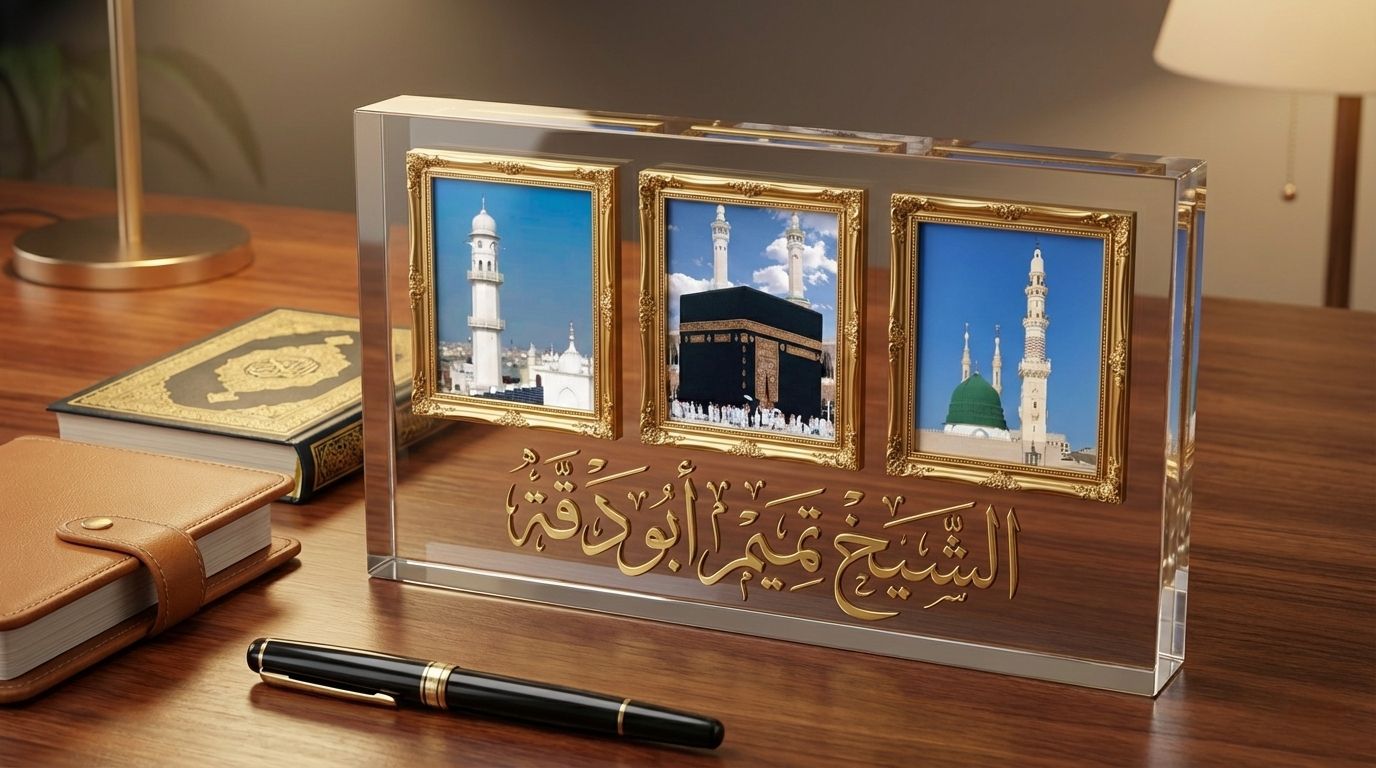

In 2003, I saw a dream in which I was circumambulating the Kaaba. Then, I saw a door beneath it open for me. I entered and found a small group of people sitting inside. There was a microphone resembling those used for recording audio, surrounded by a round mesh screen. I stood before it—I don’t remember whether I called the Adhan (call to prayer) or said something else—but whatever it was, it was beautiful and moving.
Shortly after, I was offered a position in Saudi Arabia as a project manager for computerizing the water and other facilities network using state-of-the art technology that I had built expertise in. It was a major project covering all of Riyadh. Although I disliked engaging in work that could consume me in the relentless pursuit of worldly gain—a fear I carried—I was encouraged by the dream. I felt I might serve the religion in some meaningful way through this opportunity.
When I arrived at the company headquarters, I was welcomed by the department head overseeing my project. He accompanied me as we visited other departments, introducing me generally and specifically to my project team. In one room, a staff member approached and embraced me warmly, even kissing me on the cheek. I was taken aback because I didn’t recognize him. When he sensed my confusion—and others noticed it too—he said, “I’m so-and-so from Jordan.” I replied, “Ah, welcome!” I recalled that my only previous interaction with him was once entering a drafting room at the Ministry of Water in Jordan and greeting everyone present—he had been one of them. I felt a bit embarrassed for his sake, as he clearly expected me to remember him.
Anyway, the project’s headquarters was at the Ministry of Water and Electricity in Riyadh. Our team included staff from the company (from various Arab nationalities) and employees from the ministry (Saudi nationals). Our responsibility was to train them to take over project operations after the contract ended. I held a meeting and told the staff: “I have two goals for this project: First, that we complete the work with excellence and on time; second, that each of you feels relaxed and happy, without any stress or pressure. I hope that when you go home at the end of the day and sit with your children, you feel no anxiety or tension about work. That thought brings me immense joy, and I will strive to make it happen. Also, I am ready to help any of you with personal matters—not just work—if I can. I’ll do my best to assist you in any way.”
I also told them that I wouldn’t impose fixed working hours. Instead, the work would be divided into tasks with specific deadlines. Anyone who completed their daily task early could leave for the day. For tasks that spanned multiple days, if someone could complete a week’s worth of work in two or three days, they could take the rest of the week off and still be counted as present.
I offered other benefits as well: I added an extra day off, reducing the workweek from six to five days to match the ministry’s schedule. I allocated a budget for this and did my best to create a comfortable environment.
Oddly, I noticed that my words and this system didn’t seem to bring comfort. Instead, the staff seemed confused and unsettled, which puzzled me.
Once, a Sudanese employee approached me and asked me to sign a statement that he had completed his assigned work. I asked in surprise, “Why do you want that?” He replied, “Just to have it documented.” I told him, “No one will question you as long as you follow the system I’ve put in place. But if you don’t want to benefit from the flexibility and prefer to stay in the office, that’s fine too.”
Still, the unease and distress among the staff persisted—it felt as if they were being crushed by anxiety. I felt disappointed because I couldn’t achieve my goal of making them comfortable, and I didn’t understand why.
One day, after a visit to the main company office, I was heading to my car when someone called out, “Mohammed! Someone hit your car and drove off. My friend is chasing him.” I asked where the damage was; he pointed it out, and I said, “No problem.” Shortly, his friend returned with the man who hit my car and the police. The man was a well-dressed young Bengali wearing a necklace. He apologized, explaining he hadn’t realized he’d hit my car and hadn’t meant to flee. I said, “It’s fine,” and told the police I didn’t want anything from him. One officer said they still had to take him to the station for paperwork. I requested that they complete it quickly and release him soon.
Later, I shared this story with one of the employees at the ministry who oversaw others. Several colleagues overheard it. Soon after, the Sudanese employee came to me privately and said, “I want to apologize to you!” I was surprised: “For what?” Then he explained the hidden reason behind their anxiety.
He said: “Before you arrived, when we heard your name, the Jordanian who embraced you told us he knew you well and had worked with you extensively. He said you were malicious and vengeful, biased in favor of Jordanians and Palestinians, and that you would ruin the employees here. He told me directly that I would be your primary target.
“When you arrived, greeted us, and didn’t recognize him, he told us afterward, ‘See! He’s pretending not to know me.’ Then, when you explained your work system and your intention to make us comfortable, he claimed it was all a trap—that this is how you operate: you lure people in before destroying them. So, we were constantly anxious and couldn’t understand your actions, fearing when you would strike.”
That man had abruptly left the country about 40 days after I arrived. I’d found his departure unusually quick. The Sudanese employee explained that he had gotten into serious trouble with a prince due to his lies and deceit. The prince had told him he could leave quietly or face serious consequences. That’s why he left in such a hurry—but the poison he had spread still lingered among the team.
After hearing this, I was deeply surprised. I told the Sudanese colleague, “There’s no need to apologize. You haven’t wronged me. But I feel sorry for you all. I wanted your comfort, but your suspicion and willingness to believe a corrupt person without verification is what caused your suffering. If you had trusted what I said, you would’ve felt great relief. Still, I hope you now know the truth and can enjoy the ease I intended for you for the rest of the project’s duration. May God forgive what has passed.”
This experience taught me a great lesson: when someone is consumed by suspicion, nothing you do can help. There are people who derive pleasure from tormenting others and sowing doubt and fear—even when they gain nothing from it. And many people simply cannot believe that someone might genuinely wish them well, seeking neither reward nor recognition—just enjoying their comfort and success. But that’s precisely the essence of true Islam: to be sincere in worshiping God and in serving people, providing them with peace and support.
This incident helped me understand many past situations where I had acted with an open heart and good intentions, yet others gained little or no benefit from it.
Later, after the “poison” had somewhat dissipated, we accomplished far more in six months than expected. But I lost the desire to stay. I felt this job had set my feet on a path from which there might be no return—one that could enslave me to the pursuit of worldly success. I had set a goal for myself to serve religion and often prayed to God to make that possible. So, I returned to Jordan.
Later, I realized that the dream which had encouraged me to accept the job actually meant that I would be guided to produce programs for our Islamic Ahmadiyya TV channel MTA, whose symbol is the Kaaba. My earlier interpretation of the dream was mistaken, though it turned out to be a useful mistake—it led me to accept the job and experience that remarkable situation, which taught me lessons I could never have imagined.
[8:38 م، 2026/6/20] تميم ابو دقة: The Hijab: Between Being a Sign of Submission and Inferiority in Paul’s Teachings vs. a System of Honor in Islam
In Christianity, Paul commands women to cover their heads to be a sign of their submission to men! Yes! It was not for the sake of honoring the woman, her modesty, or her chastity; nor was it for her protection, the prevention of her exploitation, or to distinguish her from those who might be viewed as objects of desire. This is fundamentally different from the purpose of the Islamic Hijab, which is not limited to a head covering, but encompasses outer garments, behavior, and conduct.
The West, and women in particular, rebelled against Paul’s teachings because he framed the head covering as a sign of a woman’s subordination to man. They viewed liberation from it as a liberation from the inferiority imposed upon them. This coincided with the desires of some men to exploit women in the most heinous ways. Consequently, they repeatedly claim that the Islamic Hijab—or rather the head covering specifically—is something shameful and a shackle that restricts the Muslim woman. However, the entire issue and its underlying philosophy are completely different.
Let us examine the text where this strange teaching of Paul appears:
{3 But I want you to realize that the head of every man is Christ, and the head of the woman is man, and the head of Christ is God. 4 Every man who prays or prophesies with his head covered dishonors his head. 5 But every woman who prays or prophesies with her head uncovered dishonors her head—it is the same as having her head shaved. 6 For if a woman does not cover her head, she might as well have her hair cut off; but if it is a disgrace for a woman to have her hair cut off or her head shaved, then she should cover her head. 7 A man ought not to cover his head, since he is the image and glory of God; but woman is the glory of man. 8 For man did not come from woman, but woman from man; 9 neither was man created for woman, but woman for man. 10 It is for this reason that a woman ought to have a symbol of authority (submission) on her head, because of the angels.} (1 Corinthians 11: 3-10)
It is worth noting here that the tenth verse in the above text has been modified in some translations to: “a woman ought to have authority over her own head,” thereby removing “the sign of submission” and replacing it with an ambiguous phrase, despite its presence in other translations. Regardless, this change does not alter the fact that the entire text speaks about the head covering and the justifications for a woman’s perceived inferiority.
Furthermore, it is not just about placing a cover on the head to declare submission; Paul also prohibits women from teaching or holding any position of authority over men. This is because he holds her responsible for the “Original Sin,” believing she must be punished by being treated as an inferior. Look at this text:
{12 I do not permit a woman to teach or to assume authority over a man; she must be quiet. 13 For Adam was formed first, then Eve. 14 And Adam was not the one deceived; it was the woman who was deceived and became a sinner. 15 But women will be saved through childbearing—if they continue in faith, love and holiness with propriety.} (1 Timothy 2: 12-15)
The issue is not limited to the head covering Paul commands; it lies in viewing the woman as being in an inferior rank, carrying the burden of sin, and being restricted to childbearing while being told to “be sensible” (propriety). This effectively casts doubt on her mental and moral capabilities just as he doubted her religious standing.
In short, women are oppressed in Paul’s Christian teachings and branded with inferiority; they must wear a head covering to announce this submission to man. It was only natural for the West, and women especially, to rebel against these discriminatory teachings that greatly diminish a woman’s status. This is originally a Western-Christian problem that led to centuries of oppression until the era of “liberalization” arrived—which also failed to rectify women’s affairs, but rather led to a massive wave of exploitation and historical injustice by turning women into commodities in the labor market.
The strange thing is that Westerners today project their own views and
historical problems onto Muslims, trying to convince the simple-minded of them! Some Christians promote the idea that the Islamic Hijab—which is much larger and more comprehensive than a mere head covering, and is an act of modesty in dress and behavior—is a sign of submission and inferiority. In reality, the concept in Islam is entirely the opposite; it is based on honoring the woman and preventing her exploitation.
Therefore, when this issue is raised, it is paramount for Muslim men and women to be aware of this historical context—which many overlook—to understand the root of the matter. The reality is that the shame lies with those who try to project their own history onto Islam and attack it unjustly, not with Islam itself, which does not use the head covering as a symbol of subordination nor adopts these deviant ideas in the first place.


No comment